Harry Bosch
The Brass VerdictHarry Bosch is a detective with the Los Angeles Police Department whose investigation into Jerry Vincent’s murder intersects with Mickey Haller’s inherited legal practice and defense of Walter Elliot. Bosch approaches Haller first as a guarded investigator, pressing him about what Vincent knew and whether the Elliot case involved bribery. Their eventual cooperation exposes how the murder may connect to corruption in the courts, while their final exchange reveals that Bosch and Haller share a father.
Identity and First Contact
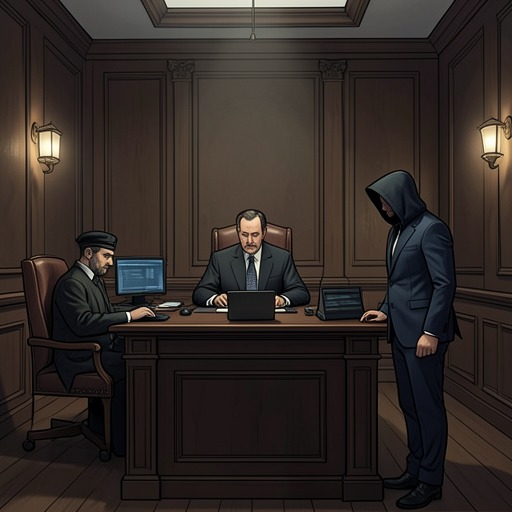
Bosch enters the story through a confrontation over Vincent’s files. Haller finds Bosch and another detective reading a stack of documents in his office; Bosch identifies himself as Los Angeles Police Department and turns the question back on Haller. Haller insists that the files belong to him and that the detectives must put them down, then reaches again for the court order he has brought. From the outset, Bosch’s investigation meets the practical limits of Haller’s role as the lawyer who has taken over Vincent’s work.
Bosch’s first assessment of Vincent’s death gives the case a more deliberate shape. He tells Haller that Vincent’s killer waited for him in the garage, knew where he would be and how to reach him, and ambushed him. Bosch adds that Haller should be careful with his new clients because Vincent knew his killer. The warning turns the murder from an isolated attack into a danger that may extend to the people and cases Vincent left behind. Haller does not yet know Bosch and is unsettled that the detective began their encounter already knowing who he was.
The two make contact again after Haller leaves a judge’s chambers. Bosch’s card is still in Haller’s pocket, and Haller calls him while walking past Parker Center on his way out of the courthouse. Their conversation begins the negotiation that their later encounters repeatedly test: Bosch is pursuing a homicide, while Haller must protect his client and respect the boundaries of his professional obligations. Bosch accepts that Haller is the lawyer, but the acknowledgment does not end his questions.
Vincent’s Murder and the Search for a Lead
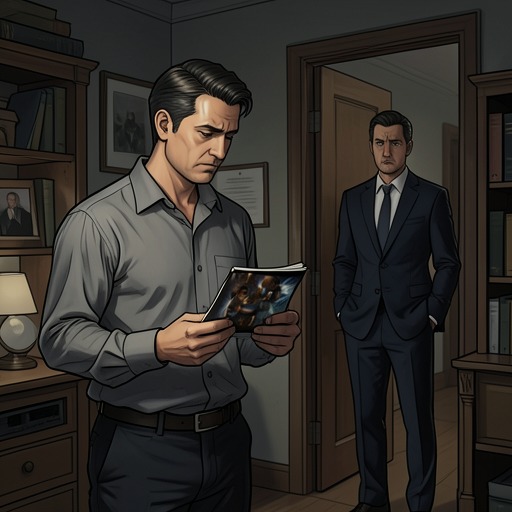
Bosch returns to Vincent’s office without an appointment and waits outside the door, listening to music with earbuds in. He appears pensive and somewhat put out when Haller arrives. The encounter soon moves beyond the ordinary preliminaries of an investigation. Bosch asks who Vincent bribed in the Elliot case, a question that reveals his concern is not confined to identifying the person who killed Vincent: he is also testing whether Vincent’s legal work concealed a payoff.
The question has force because the evidence surrounding Vincent is incomplete and troubling. Haller discusses call records showing that Vincent received calls from the Bureau on the day he died and several days earlier. He also describes Vincent’s collection of one hundred thousand dollars in cash. The broker had to order that amount, and Vincent explained the withdrawal as money for a boat purchase that would save him money. There was no boat; the explanation was false. These details sharpen the possibility that Vincent had been involved in something beyond ordinary defense work, but the cited exchanges do not establish that Bosch himself uncovered the cash or the call records. Bosch’s part is to press the central suspicion and seek an account Haller is unwilling or unable to provide.
The murder investigation remains stalled. Bosch later admits that he is approaching seventy-two hours without a suspect or a viable lead. He invokes the first-forty-eight-hours principle: the likelihood of solving a homicide falls sharply when investigators fail to make progress early. He had hoped that pressure might make Haller disclose something useful. Haller is taken aback by the admission that Bosch suspected him of withholding knowledge of Vincent’s killer. Bosch’s disclosure makes his earlier probing more legible: it comes from investigative urgency, but it also strains the trust required for cooperation.
When Bosch asks whether Haller will help him, the request follows his admission that the investigation has produced nothing. Haller’s response is skeptical, reflecting the conflict between Bosch’s need for information and Haller’s insistence that he cannot simply disregard his responsibilities to clients. Their exchange does not resolve that conflict; instead, it establishes the terms of an alliance that remains conditional and sometimes adversarial.
The Elliot Case and the Corruption Investigation
The Elliot case gives Bosch’s questions about Vincent a wider significance. During a later confrontation in Haller’s office, Bosch argues that the intruder who had been there must have come for a purpose. He reasons that the visitor may have sought something in the office or in one of the files that could identify Vincent’s killer. Bosch is frustrated that the assailant had been within reach and that Haller cannot point him toward a decisive clue.
Haller answers with the limits of what he has found. His case manager and investigator have searched, and Vincent’s receptionist had worked in the office until she quit that day. Haller says that his review of the Elliot file has shown no indication that Vincent bribed anyone. More than that, he says Vincent had a strong defense—a “magic bullet”—and a chance to win the case without a bribe. The disagreement exposes two distinct investigative readings: Bosch suspects that a concealed payoff may explain Vincent’s circumstances, while Haller sees a viable legal strategy that makes bribery unnecessary. Bosch’s suspicion is not presented as proof, and Haller’s review does not settle the question of what Vincent may have done outside the file.
Bosch eventually discloses why the Bureau had been interested in Vincent. A few days after the murder, the Bureau told Bosch that Vincent was a person of interest in its examination of the state courts. Vincent was among lawyers whose names had surfaced through rumors about favors they claimed they could obtain and connections they claimed to possess. The Bureau invited him to cooperate as a witness; he declined, and pressure on him was increasing when he was killed. Bosch had not told Haller this earlier, explaining that Haller did not need to know. The delayed disclosure changes the context of the murder: Vincent’s death now sits beside a broader inquiry into possible corruption, though Bosch’s account does not by itself establish why Vincent was killed.
The investigation reaches a public turning point when Bosch tells Haller that a grand jury has returned indictments. The named defendants are Judge Holder, Mitch Lester, Bruce Carlin, David McSweeney, and a woman who supervises the jury office and provided access to its computers. Bosch says they are to be arrested simultaneously and asks Haller to keep the information confidential until everyone is in custody. Haller recognizes the trust involved in receiving advance notice, while also warning Bosch that a case involving a judge must be firmly supported. Bosch’s report links the investigation to a coordinated response against alleged court and jury-system corruption.
An Uneasy Working Relationship
Bosch and Haller’s relationship is shaped by competing rules rather than easy agreement. Haller frames them as working from opposite sides of the same coin: each has obligations, and Haller will not trample on his clients’ rights to assist the police. Bosch accepts the lawyer’s position but continues to test its boundaries. His questions about Vincent’s possible bribe repeatedly bring the two back to the same divide—what Bosch needs to know to solve a murder, and what Haller can disclose while defending a client.
At another point, Bosch demonstrates how closely Haller’s movements have been observed. He recounts Haller’s dinner with a client at Water Grill, including their meal, raised voices, the client’s drinking, Haller driving him home in the client’s car, and Haller’s later stop at Book Soup to make a phone call. Haller is impressed by the accuracy and accepts that people are watching, though he remains unsure what Bosch wants from him. The episode makes the investigation feel present even outside the police station or courtroom: Haller’s ordinary movements have become information Bosch can use to establish that the threat around him is real.
That threat becomes immediate when Bosch reaches Haller during the office crisis. Bosch arrives within six minutes after Haller calls; both men have guns at their sides when Haller lets him in. Bosch insists that the person who came to the office must have been looking for something, and presses Haller to consider what in Vincent’s files could expose the killer. Their proximity to danger does not remove their disagreement, but it makes the investigation a shared physical risk rather than a debate at a distance.
Later, after Haller has been attacked at a canyon overlook, Bosch is present among the responding law-enforcement officers. Haller, who has taken cover, sees Bosch above him and is told that he can get up. Bosch remarks that Haller cut it close. The brief exchange confirms Bosch’s arrival at the scene and gives their working relationship a different weight: the detective who once suspected Haller of withholding information is now there when Haller’s own safety is at stake.
Family Recognition and Narrative Role
The connection between Bosch and Haller emerges at the end through a personal recognition rather than a formal explanation. Haller tells Bosch that they are flip sides of the same mountain and that Bosch looks a lot like his father. Bosch does not answer immediately; he looks at Haller, nods, and turns his gaze toward the city. He then asks when Haller put the resemblance together. The exchange confirms their shared father and recasts their earlier rapport as more than a partnership between a detective and a defense lawyer.
Bosch’s role in the story depends on that double position. He is an investigator who must pursue Vincent’s killer and follow the Bureau’s corruption inquiry, but he is also Haller’s newly recognized half-brother. His approach remains guarded: he keeps information back, asks pointed questions, and seeks help when his own leads run out. Yet the later disclosures and his presence at the canyon show a relationship moving toward trust, even though their professional obligations remain different. The family revelation does not erase their conflict over evidence and confidentiality; it gives that conflict a deeper personal frame.